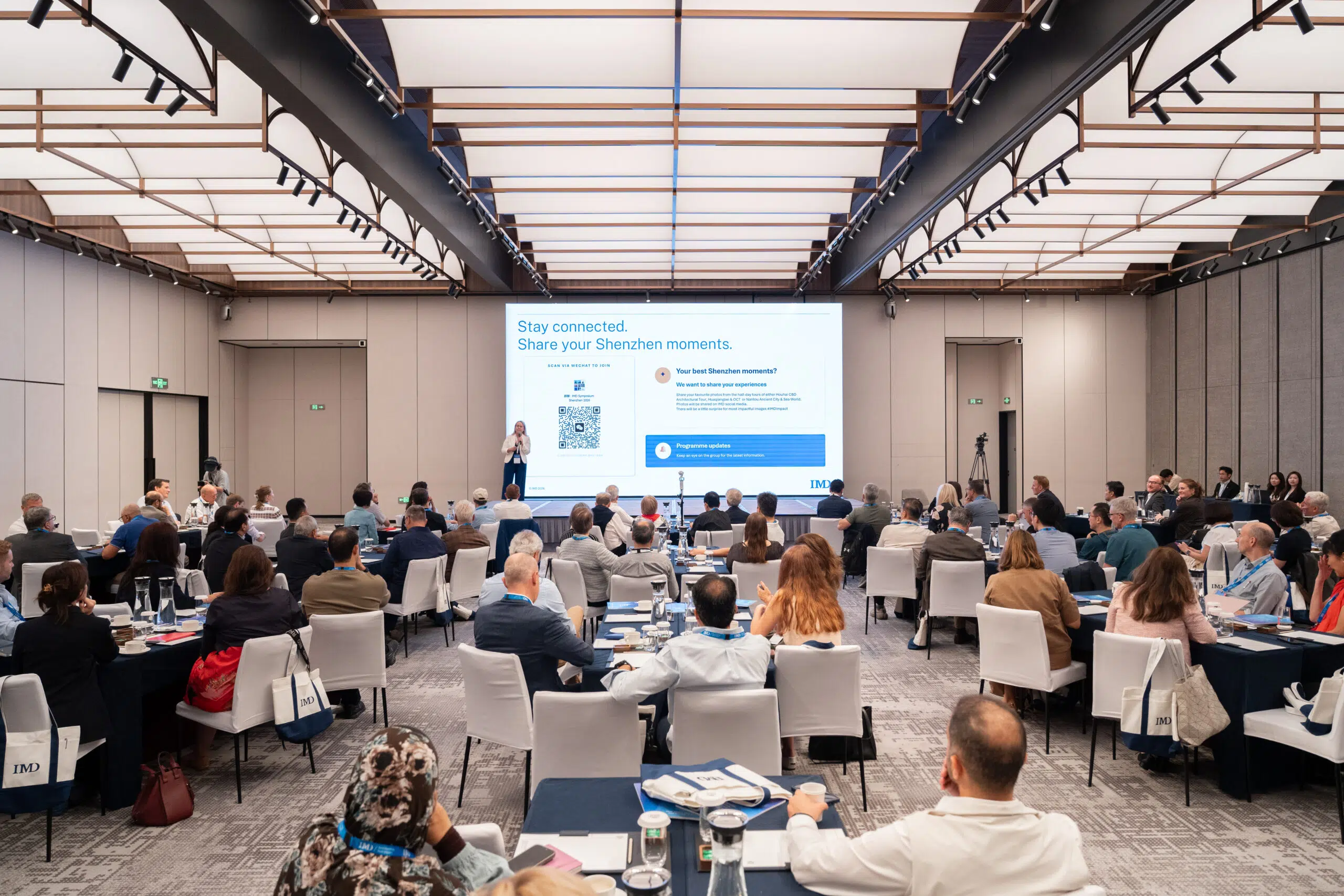
IMD’s 2026 International Alumni Symposium, held outside Lausanne for the first time in its history, took participants behind the scenes of one of China’s most dynamic innovation ecosystems. For nearly 80% of the alumni attending, it was their first visit to Shenzhen, while some were experiencing China for the first time. Over two days, they would hear from entrepreneurs and business leaders, explore the city, and get a closer look at the companies driving its development.
Welcoming participants, IMD President David Bach emphasized the importance of learning directly from leaders in dynamic regions.
“We need to be connected to where the action is around the world,” he said, highlighting IMD’s ambition to deepen its engagement in high-growth markets.
The symposium opened with a conversation with an alumnus who has spent more than a decade building a business in China’s fiercely competitive automotive industry.
Speed is the competitive edge
When Brian YinJen Chen (MBA 2011) chose China over Silicon Valley to launch Voyager Intelligent Systems in 2013, he saw an opportunity in the country’s growing automotive industry.
In a fireside chat with Bach, Chen recalled the challenging early years of building a technology company, overcoming repeated setbacks, and adapting to the demands of manufacturers.
Today, Voyager supplies automotive technologies to leading carmakers in China and internationally. In a market where competitors can quickly replicate new technologies, speed is critical.
“If you’re not 70% ready, you can’t even be at the table,” he said, describing how suppliers are expected to have a working product largely developed before bidding for a project.
Chen also spoke about the importance of understanding China’s industrial policies and working with other suppliers, sometimes even competitors, to meet customer demands.
For international businesses, he sees opportunities to pair the speed of Chinese innovators with the established networks, market knowledge and relationships of global partners.
Shenzhen: A living innovation ecosystem
The afternoon took alumni beyond the conference room to explore different sides of Shenzhen.
At Shenzhen Talent Park, China’s first municipal park dedicated to talent, a drone food-delivery service offered an example of technology finding its way into everyday life. Meanwhile, Huaqiangbei, home to more than 115,000 businesses, showcased the scale of the city’s electronics industry and its growing role in AI hardware.
The groups also explored Overseas Chinese Town’s cultural and creative spaces, and Nantou Ancient Town, where nearly 1,700 years of history sit alongside new ambitions for design and creative industries.
Together, the visits offered different perspectives on a city where technology, entrepreneurship, culture, and urban development are closely connected.
China as an innovation gym
In his keynote, The State of China Innovation, Mark Greeven, Professor of Management Innovation at IMD, examined what makes Chinese companies so fast and competitive, and what businesses elsewhere can learn from them.
“Maybe China is no longer the market. Maybe China is the gym,” he said.
Greeven described a pattern he calls “swarm competition”, where new opportunities attract large numbers of companies, followed by fierce competition and consolidation. Those that survive learn to innovate quickly, cut costs, and deliver what customers want.
And the story goes well beyond electric vehicles. Greeven pointed to advances in AI, robotics and life sciences, even as China grapples with weak domestic demand, local government debt, and geopolitical tensions.
For international companies, China may be worth investing in as a place to innovate, even when it is not their primary market. Greeven urged leaders to examine the management practices and organizational structures that allow Chinese companies to move so quickly, and consider what they could apply to their own businesses.
The symposium continues on Monday with visits to Huawei, Lenovo, and the Qianhai Shenzhen-Hong Kong Youth Innovation and Entrepreneurship Hub, giving alumni a closer look at how companies are putting some of these ideas into practice.

