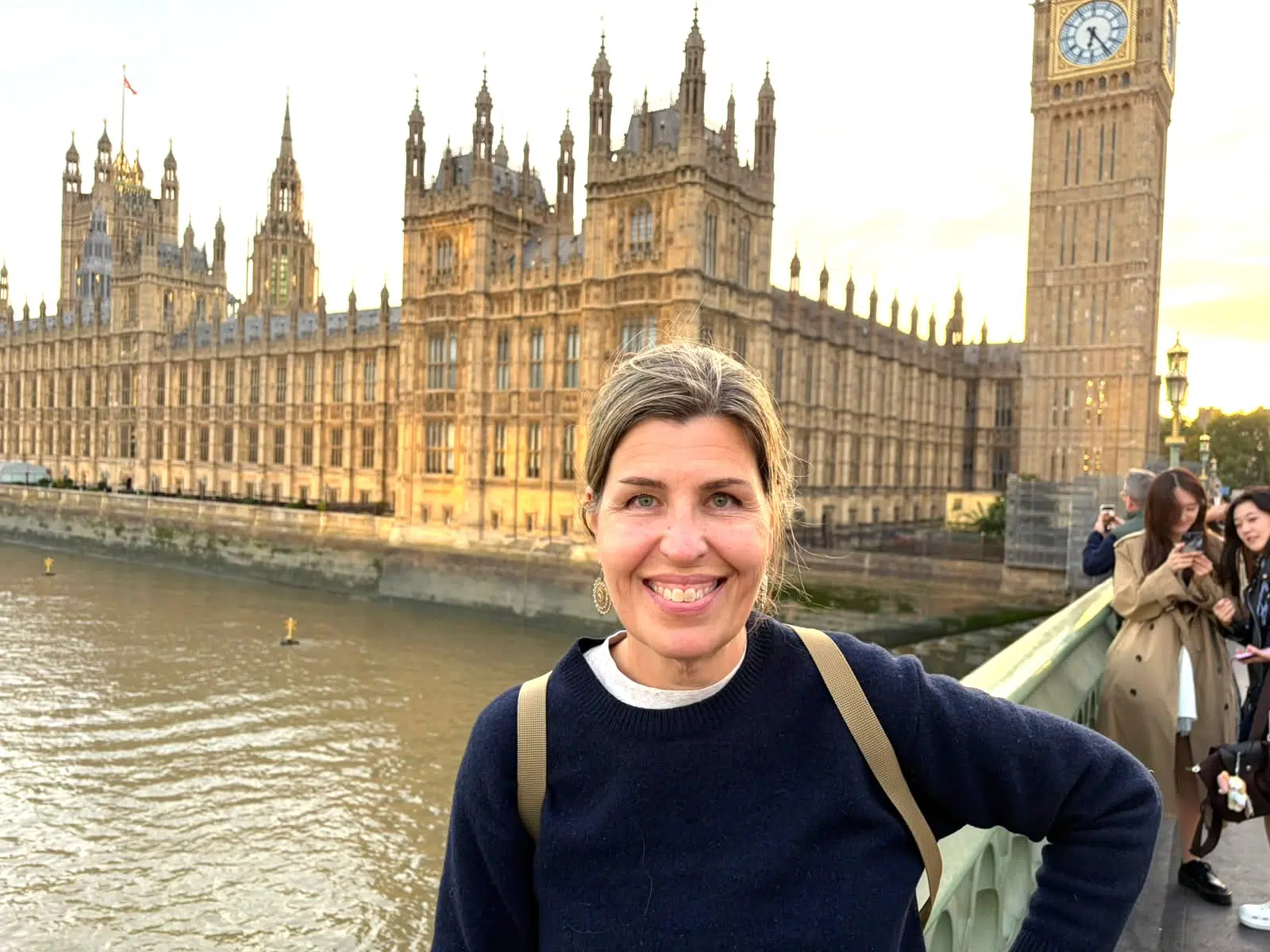
Careers rarely unfold in a straight line. For Annelie Wirdefeldt, VP Strategy Execution & Governance at Securitas, the defining moments have often come from recognizing an opportunity, stepping into unfamiliar territory, and discovering where she could make the greatest difference.
“You begin in one area convinced that it is where you belong. Then you are exposed to something new, see its potential,and want to explore it further. Those opportunities can change the direction of your career,” she said.
Wirdefeldt first studied political science, a subject she enjoyed but did not ultimately see as her professional path. She moved into business and joined Securitas in corporate communications at the company’s Stockholm headquarters. Over the following 19 years, her work would take her far beyond a traditional communications role and increasingly closer to the heart of how the company develops, leads and executes change.
“The Group function was much smaller then – around 40 people compared with close to a hundred today. It gave me the opportunity to work broadly and to see how different parts of the business connected,” she said.
Her title was Corporate Communications Manager, but the role often resembled that of an internal advisor. She worked across public relations, investor relations, branding, and digital communications, supporting initiatives across the organization. After she returned from parental leave following the birth of her third child, another opportunity emerged – one that would shape both her own career and Securitas’ commercial development.
Changing how we work
The story began in 2010, when Bart Adam, then leading the European division, set the Commercial Toolkit program in motion. Its ambition was practical but significant: to create a more consistent, professional, and client-focused commercial approach across Europe.
Wirdefeldt took responsibility for managing the initiative and leading training sessions in several countries. The work focused on shared sales processes, stronger account management, and a more systematic way of understanding the needs of prospects and clients.
“We wanted to become more systematic and professional, and to bring a stronger outside-in perspective to every relationship with prospects and clients,” she said.
It soon became clear, however, that tools and processes were only part of the equation. The real challenge was changing behavior: helping people understand why a different way of working mattered and turning that understanding into everyday practice.
“We did not set out by calling it change management. But after the first sessions, it became obvious that this was exactly what we were doing,” she said.
That insight has stayed with her. Change is not achieved by announcing a new direction or introducing a new tool. It happens when people understand the case for change, see their role in it, and are supported in translating ambition into action.
There is no shortcut
“There are no tricks. Change asks people to move toward something unfamiliar, and that is rarely comfortable,” she said.
The starting point is therefore clarity: why the change is critical, what is at stake if the organization stands still, and how the change connects to each person’s work.
“The ‘why’ has to be clear – why this is critical for the company and for our long-term success. But people also need to understand what it means for them. Both perspectives matter,” she said.
Over the following years, many colleagues participated in workshops, typically lasting two to three days. The head of the European division owned the program, while Wirdefeldt managed the project together with a Deloitte consultant in Belgium. The approach evolved continuously as feedback from clients and colleagues was translated into improvements.
The impact extended beyond the workshops themselves. The program strengthened a disciplined, client-centered way of working at a time when Securitas was preparing for a much broader transformation.
“It made a real difference – not only to commercial capability but to how we worked with clients and with one another,” she said.
At the time, Securitas was primarily associated with on-site guarding, mobile guarding, and monitoring services. Since then, the company has built a substantial technology capability and developed a broader offering. Throughout that evolution, the disciplined focus on understanding clients and delivering consistently has remained fundamental.
“The way we engage with clients has changed substantially. We are more consistent, more systematic, and better able to connect our services to what clients actually need,” she said.
Preparing for what’s next
For Wirdefeldt, 2014 marked another important step in that progression. Alongside her role as program director of the Securitas Management Training program for the European division, she took responsibility for several major people and HR initiatives across Europe. From 2014 to 2018, she helped build a talent management program, developed and drove the employee survey for approximately 100,000 employees – including front-line colleagues – and managed the network for country HR managers across the division. The programs proved relevant well beyond Europe and were subsequently introduced in other Securitas divisions, turning regional initiatives into approaches with broader group-wide reach and value.
Moving from communications into commercial capability-building, leadership development, and people programs gave her a broader view of how organizations change – and of the role leaders, structures, and employee engagement play in making that change real. It reinforced a lesson that would become central to her later work: strategy only creates value when people understand it, commit to it, and can translate it into action.
During Alf Göransson’s tenure as president and CEO, which ended in 2018, Securitas continued to develop its strategy, capabilities, and offering. When Magnus Ahlqvist became president and CEO in 2018, Wirdefeldt’s own journey took its next turn as she moved into strategy execution and governance. The role brought together much of what she had learned: how to communicate a direction clearly, build capability, engage leaders, and create the structures that help an organization follow through.
“During 2018 and 2019, we held a series of intensive three-day sessions with IMD in Lausanne. We explored the choices that would shape the next phase of Securitas – innovation, digitalization, combining guarding with technology, management, and how we needed to evolve as a company,” she said.
For Wirdefeldt, the sessions confirmed that her different experiences were not separate chapters, but parts of the same professional journey: helping people understand change and creating the conditions for execution.
The connection between meaning and change became even more tangible in 2019, when Securitas launched its purpose: “We help make your world a safer place.” More than a statement, it gave employees a shared answer to a fundamental question – why their work matters. It connected individual roles, including those of frontline colleagues, to Securitas’ wider contribution to society: helping to make communities, workplaces, and everyday life safer and more secure.
For Wirdefeldt, purpose and change are closely connected. A transformation is easier to understand – and more meaningful to support – when people can see not only what the organization is trying to achieve, but also the positive difference they help create through their work.
From strategy to action
The development of InSight 2030 was a separate, internally led process. Wirdefeldt was part of that work, which was driven by her new colleague Jonas Lundin. Her role has since increasingly focused on the bridge between strategy and execution: following progress, strengthening commitment, and creating forums in which leaders can engage with the strategy, challenge assumptions, and learn from one another.
“I have had the opportunity to work with change from several different perspectives,” Wirdefeldt said. “What connects them is the need to make the direction meaningful and actionable. Our purpose gives us a clear and human ‘why’: the contribution we make to society and to people’s everyday lives. Today, my focus is on following up our progress through the Group’s objectives and key results (OKR) work, and helping to strengthen commitment and engagement through initiatives such as Strategy Bootcamps and strategy networks. They create space for leaders to connect that bigger picture to their own responsibilities and to keep moving the strategy forward together.”
Viewed as a whole, her career has been shaped by a consistent question: what does it take to move from ambition to action? Commercial development taught her the importance of an outside-in perspective. Leadership and people programs showed her that change depends on capability, commitment, and engagement. The launch of Securitas’ purpose reinforced the power of a shared “why.” Strategy execution has brought those lessons together through disciplined follow-up and networks that help leaders connect purpose and direction to tangible progress.
“There is no doubt that AI will change every industry. We do not yet know exactly how far or how fast, but we need to understand the implications, act on the opportunities, and remain clear about the value we create for clients,” she said. “That is what continues to motivate me: learning, connecting the bigger picture to practical action, and helping the organization move forward.”

