Ask Norbert Buil how he thinks about his career and he reaches for the same image: a wall, built one brick at a time.
Trained as an engineer, he moved into auditing at EY to master the foundations of finance. M&A taught him how businesses create value through transactions, before eight years at PPG, a global coatings and specialty materials company, broadened his perspective beyond finance into operations, manufacturing, R&D, and strategy.
Then Buil had a simple realization: he still had another 20 or 30 years of his career ahead of him. Rather than continuing to rely solely on hands-on practice, he decided it was time to return to the classroom. “Having learned primarily through experience, I wanted to complement it with structured, formal learning from a world-class faculty.”
Finance had given him technical depth, but he wanted a broader understanding of business, from strategy and marketing to customer insight and leadership. Just as importantly, he wanted to challenge his thinking alongside executives from different industries and backgrounds.
A different kind of classroom
Coming from France, Buil’s frame of reference for business schools looked different. But as he explored his options, one aspect stood out. “What appealed to me about IMD was the diversity of industries and the seniority of the participants.”
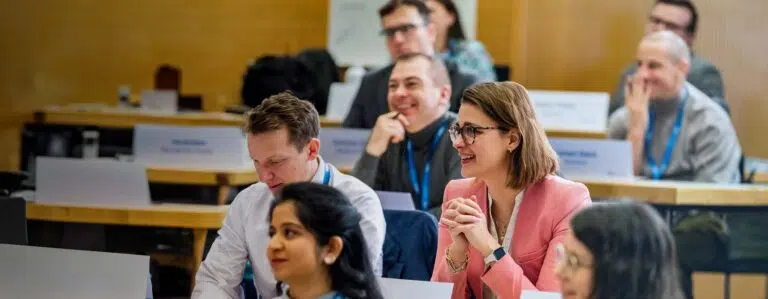
Working alongside more than 50 seasoned executives exposed him to different ways of thinking about leadership, decision-making, and business itself. “The first few days after you join the EMBA program, you realize how successful these people have been,” Buil reflected. “Then, as you build personal relationships with them, you understand their struggles, and that’s what creates genuine bonds.”
It was a reminder that leadership is less about having all the answers than recognizing that everyone, however accomplished, is still learning.
“We started as professionals and foreigners,” he added. “At the end we became friends.” Those friendships have endured well beyond graduation. The cohort still meets regularly, stays in touch almost daily, and supported him through one of the biggest transitions of his career.
The program also challenged participants to better understand themselves and the influence they had on others.
“Leadership is about knowing yourself, knowing the influence that you have on others, and being able to adapt yourself,” Buil said. “It’s about bringing people together to achieve common goals.”
The pain reliever
Midway through the program, a reorganization at PPG meant Buil suddenly found himself navigating an executive career transition. Almost simultaneously, the Executive Career Management Module (ECMM) began.
The most important lesson wasn’t about CVs or interviews. It was about perspective. “As an experienced executive, you’re not a job seeker. You’re a solution provider,” said Buil. “More than anything, you’re a pain reliever.”
Instead of asking, ‘What have I achieved?’ Buil began asking, ‘What business problems am I uniquely equipped to solve?’
“If you have this mindset shift,” he reflected, “it changes everything.”
Businesses succeed by understanding their customers’ problems rather than falling in love with their products. Careers, he realized, are no different.
“You must not fall in love with your career. You must not fall in love with your achievements. You have to understand what the pain is for the person across the table, and demonstrate how you can solve it.”
The Executive Career Management team helped him rethink how he communicated his experience, from rebuilding his executive profile to strengthening his online presence. Using the STAR framework, he learned to present not simply what he had done, but the business challenges he had solved and the measurable impact he had delivered.
Five months later, a headhunter contacted him about the role he now holds as Chief Financial Officer at ExcellGene, a private equity-backed life sciences company.
Science for value creation
His new role offered an immediate opportunity to put those lessons into practice.
ExcellGene had been built by prominent scientists pursuing scientific excellence. Following the acquisition by private equity investor ARCHIMED, the company placed greater emphasis on commercial growth and value creation, not replacing scientific ambition, but connecting it more closely to customers, strategy, and long-term development.
“That is a deep cultural change,” Buil said. “As a leader, your role is to make this change happen, and to help people embrace it, while recognizing that it can be a difficult journey.”
It is here that the leadership lessons from the Executive MBA have become most tangible. “I’m much more of a listener,” he shared. “I also try much harder to understand the other perspective rather than immediately going to the first solution I see.”
A better version
Looking back, Buil deeply believes the Executive MBA helped him become a more complete leader.
“I became a better version of myself,” he reflected. “I originally came for the academic learning. I left with a profound personal impact and a great network of friends. Both will have long-lasting effects on my personal and professional future.”
Today, that wall is still being built. And when the next opportunity comes, Buil knows he’ll approach it the same way he always has: by asking not what role comes next, but what there is still left to learn.
For him, the Executive MBA was never the destination. It was simply another brick in the wall he is still building.