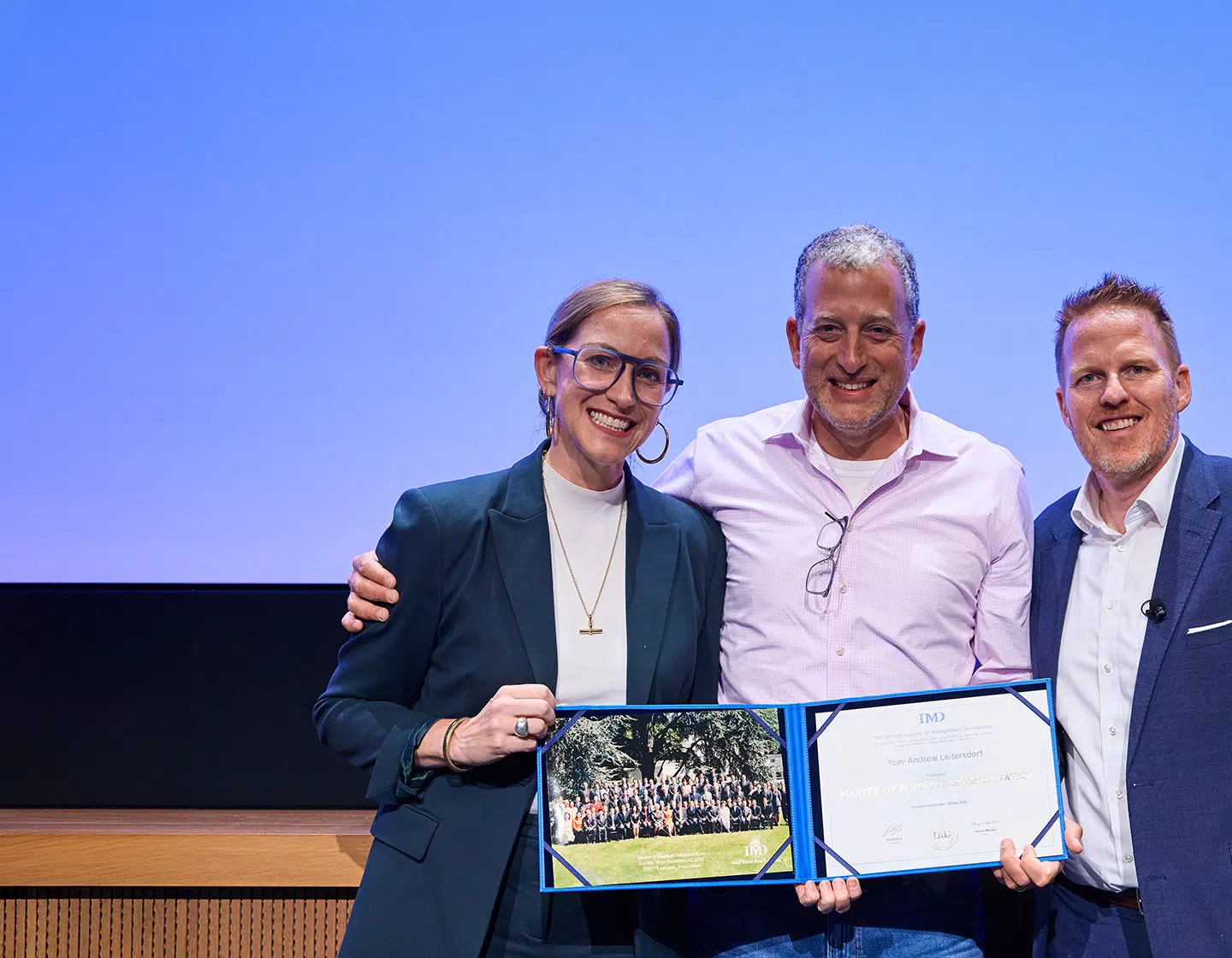
For Leitersdorf, founder and managing partner of the cybersecurity venture capital firm YL Ventures, the moment was less about the parchment than about what it represented: a friendship group and a professional network that has quietly shaped almost every major decision of his adult life.
“It’s not like I needed another MBA degree,” he says, “but on the personal side it feels right, because I feel like I really am part of this institution. I’m a part of the class and I feel a great affinity for IMD.”
An unconventional route in
Leitersdorf’s path to IMD was already unusual. He never attended university, having instead built and sold two technology companies by his mid-20s, the second being a payments business that was sold in 1999. Rather than starting an undergraduate degree, he applied directly to MBA programs. IMD took a chance on him, treating his entrepreneurial track record as the equivalent of a first degree.
The gamble paid off in both directions. Leitersdorf describes an “amazing” MBA experience, singling out finance as the area that reshaped his thinking most. But by August of that intensive one-year program, with the dot-com crash unsettling the technology sector he had built his career in, he decided he was not finished studying. IMD’s program was fixed at one year, so when Columbia University offered him a place to continue for two more years – giving him time to deepen his knowledge of finance and marketing – he took it, arriving in New York just before 9/11. It was, he admits, “a very strange move, because if you’re just a few months away from graduation, most people will just hang on and graduate.”
Whatever administrative loose ends that decision created, the ties he had already formed in Lausanne did not loosen with distance. “I stayed in touch with IMD and with my classmates, and it’s been a great relationship since,” he says – one that, he is quick to point out, never developed in quite the same way at Columbia.
A network that compounds
Ask Leitersdorf what he actually got from his year in Switzerland, and the answer is not a finance framework or a case study. It is people. The Class of 2001 has remained connected for a quarter of a century, alongside periodic reunions and alumni events, and now through a WhatsApp group. A tight circle of close friends still takes holidays together, visits him in California, and hosts him in return.
It goes deeper still. In 2004, Leitersdorf co-founded a technology business with two IMD classmates. Through that venture, he met a Dutch customer of the company – Lilian, who became his wife. The couple lived in Amsterdam, later moved to the San Francisco Bay Area, and now have three sons, aged 12, 13, and 14. “If I hadn’t been to IMD, I would not have met my IMD friends and business partners, through whom I met Lilian, and I would never have had my three boys,” he says.
It is a chain of cause and effect he returns to often: a marriage, a family, and two decades of venture investing, all tracing back to a single year in Lausanne. By contrast, he says frankly, his relationships from Columbia – bigger, more American, more transactional in feel – never came close. “It’s intimate, it’s personal, it’s beautiful, it’s small, and it’s got very special people from all over the world,” he says of IMD, recalling in particular the influence of the late J Barkev Kassarjian, who, as IMD’s Professor Emeritus of Strategy and Organization, would invite students to his home for wide-ranging discussions on business and organizations.
Advice for the class of the future
Leitersdorf has built a successful business, but is candid about the mistakes made as he developed YL Ventures over 19 years – making calls on which companies to back, when to exit and when to hold.
Looking at current trends in tech, Leitersdorf regards AI as the defining test for the next generation of graduates. He believes it will not merely nibble at the edges of the job market but fundamentally reshape it – in cybersecurity, where he invests, as well as in finance, consulting, general management, and education. His advice to alumni and current students alike is to design careers deliberately around that reality rather than hope it passes them by. “You can’t fight them, you’ve got to join them,” he says. “How do you make AI into an enabler for yourself, as opposed to something you’re trying to fight?” It is a question he weighs personally, too, as the father of three teenage boys building their own futures.
For an institution that prizes diversity of perspective, Leitersdorf’s own IMD story is a reminder of how far-reaching, durable and influential that mix of backgrounds can be – not just in the classroom, but in a life. Twenty-five years, one very late degree, and one enduring class WhatsApp group later, he remains, by his own account, “extremely grateful and humbled.”
Accepting his degree, Yoav Leitersdorf reflected on his time at IMD and the enduring friendships he forged.
“I arrived in Lausanne in January 2001 with a suitcase, a laptop, a snowboard and nowhere to live, in an era so distant that there was no Wi-Fi in the auditoriums.
“I learned a great deal during my time here. Not just about business, but also about perseverance, teams, valuing different perspectives, and about myself. I have maintained great friendships with my IMD classmates from all over the globe. And IMD shaped the way I view the world and how I lead.”
One memory stood out above the rest: ten classmates traveling from Lausanne to work with NGO Gram Vikas in India, on a social-impact project they created themselves, teaching business courses to adult Tibetan refugees. “Giving back in this way was a highlight of my IMD experience,” he said. The group was so remote that one student declared, “Even God takes 100 days to reach here!”
That same class of 2001 network resurfaced through every chapter that followed. “Fast forward to 2004, and I started a tech business with two IMD classmates,” he says – and three fellow alumni later became early investors in YL Ventures, founded in 2007. “I remain very grateful for their backing.”
He closed on the line that characterized the whole occasion: “Legacy is not simply measured by careers, titles, or financial success, but by the people who shape our lives and the lives we shape in return. The friendships formed here, the risks we took, the families we built, and the opportunities we created for others have become far more meaningful than anything we could have imagined back in 2001.”
For that, he told more than 400 MBA alumni who had gathered for multiple class reunions at the IMD campus, “I will always be deeply grateful.”