
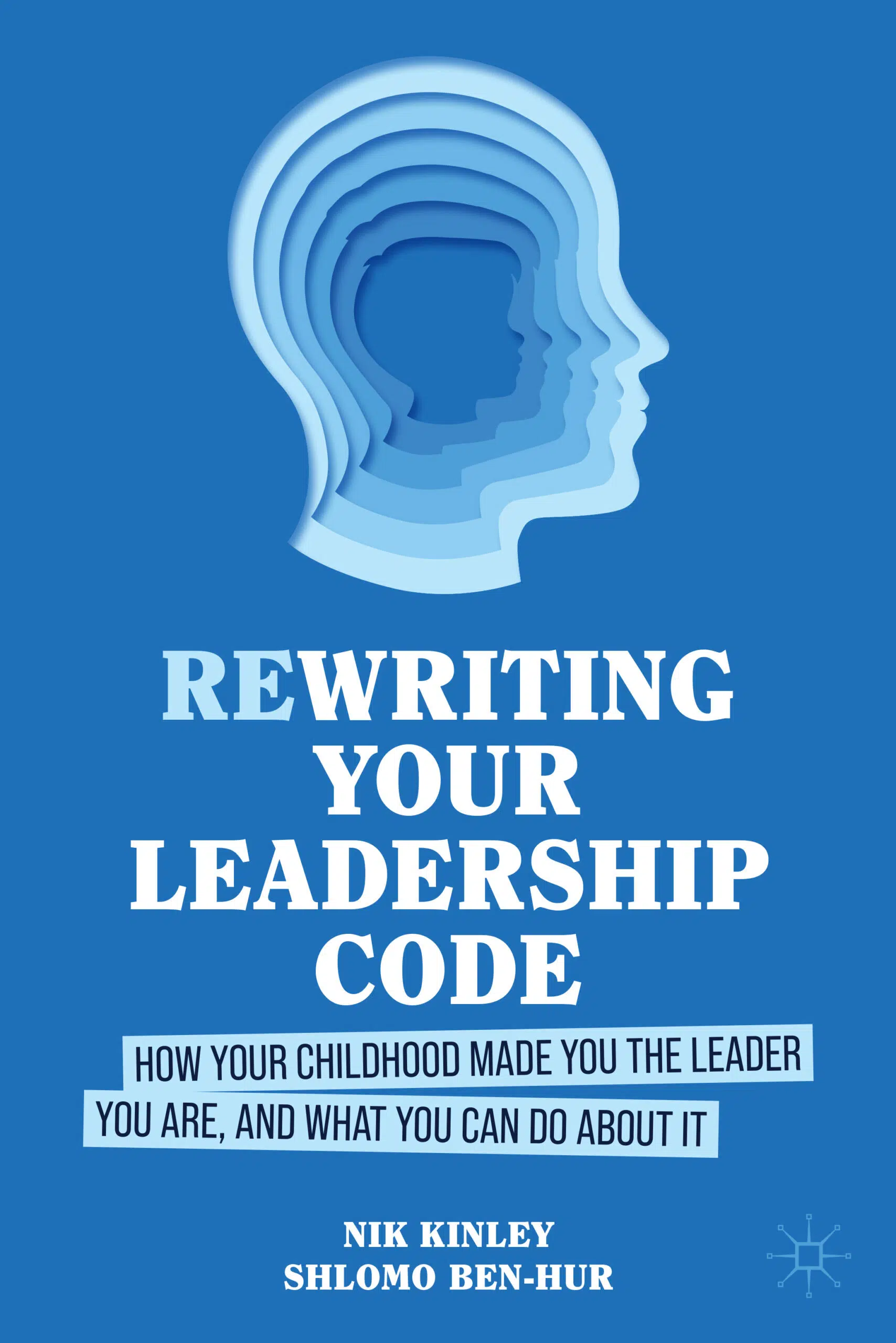
Rewriting Your Leadership Code
A must-read for all leaders who want to make a difference to the quality of their leadership in times of change. Brilliantly researched, excitingly written, it is an exploration to the core of leadership.
Masterfully unveils the profound link between our pasts and our leadership, presenting a clear roadmap connecting childhood events to impactful leadership. A game-changer in self-discovery and leadership evolution.
Life as a leader is busy and intense, and it is easy to forget our past. But our past does not forget us. This book explains how it impacts our behaviour and decision-making as leaders and, by extension, the results of the whole organisation.
Where do your leadership instincts come from and how can you improve them?
Stretched by heavy workloads and facing ever more complex environments, leaders increasingly find themselves running on automatic and relying on their instincts. But depending on instincts is a bit like gambling, and as a result, stress levels, mistakes and failure rates are all on the up.
In this ground-breaking book, leadership experts Nik Kinley and Shlomo Ben-Hur reveal how our instincts are the products of childhood experience – lessons learnt that have become written into the structure of our brains. Like the source code at the centre of a computer, they underpin almost every aspect of our functioning as leaders. They affect how we interpret and experience things, how we react to events, the environments we choose, the impact we have on people, and even the responses we trigger in others.
Often these instincts and tendencies are hidden beneath professional poise. But under pressure, when we are deprived of time, they come to the fore. This is why leading under pressure can bring out the best and the worst in us. And it is why – ultimately – leadership is a test of the character of our instinctual code.
Based on decades of research, this book shows how we get to be the leaders we are today. It explains the tendencies and inclinations that past experiences can leave us with and the hidden ways in which they can affect who we are as leaders and how we behave. And crucially, it shows how we can make better use of our instincts and even improve them to become better leaders.
Out Now!
Research Information & Knowledge Hub for additional information on IMD publications
Purpose As economies transition towards increasingly formalised, market-driven and capitalistic structures, this study examines why entrepreneurs choose to initiate their businesses informally. Drawing on new institutional economics and the exter...
Amid rising global mental health challenges among employees and leaders, this research examines how leader mental health disclosure—sharing sensitive information about a mental health condition—shapes followers' perceptions of the leader and the q...
Since its debut race in 1978, the Ironman brand has defined and dominated the triathlon world. By 2026, the Ironman Group (IG) organized over 160 triathlon races across the world, registering a record 250,000 competitors in 2025. Ironman was argua...
The Saudi Electricity Company (SEC) was established in 2000 to provide proper oversight and regulation to ensure the efficiency and sustainability of Saudi Arabia's electricity industry. Over the years, some progress was made but by 2020, the deci...
Henkel looked toward the newly established Henkel Consumer Brands (HCB) to become a resilient platform for long-term growth. To guide the transformation, HCB tapped into a framework named ASPIRE, referring to the ideal supply chain attributes of A...
in International Journal of Entrepreneurial Behaviour and Research December 2026, vol. 32, no. 1, pp. 488-513, https://doi.org/10.1108/IJEBR-11-2025-1717
Research Information & Knowledge Hub for additional information on IMD publications
in Applied Psychology: Health and Well-Being December 2026, vol. 18, no. 6, e70243, https://doi.org/10.1111/aphw.70243
Research Information & Knowledge Hub for additional information on IMD publications
in I by IMD
Research Information & Knowledge Hub for additional information on IMD publications
in I by IMD
Research Information & Knowledge Hub for additional information on IMD publications