The value of LGBTQ+ inclusion in today’s uncertain DE&I landscape
Companies gain performance advantages through LGBTQ+ inclusion, yet nearly nine in 10 Swiss firms lag. Here’s how leaders can close the gap....

by Tomoko Yokoi Published October 12, 2023 in Technology • 6 min read
 The internet is not just for gamers, Netflix viewers, and subscribers to music-streaming platforms. Online offerings nowadays include educational opportunities, opportunities of economic participation, and an array of basic public services. Internet access is becoming an essential aspect of modern life and social and economic equality in today’s world requires digital equity.
For now, however, that equity is sorely lacking. In the US, more than 40m people lack adequate access to broadband internet. Even in the EU, regarded globally as an advanced region in terms of digital access, around 11m citizens (2.4% of the EU population, rising to 7.6% among those considered at risk of poverty) suffer from the same problem.
At the recent Tech Summit 2023 hosted by the Asian Pacific American Institute for Congressional Studies (APAICS), I moderated a panel devoted to addressing exactly this challenge. It is clear that bridging this gaping digital divide requires significant effort from a broad range of stakeholders. The price to pay for failing to confront this issue is too high for us not to make that effort. Both public and private sectors will need to play their parts. Some initiatives will operate at national or even international level; others will need to be much more local.
We are already seeing the hugely problematic consequences of digital inequity. At the beginning of the Covid-19 pandemic, the National Education Association warned that one-quarter of US students lacked access to remote education. In the UK, the Royal Geographic Society warns that up to 90% of jobs now require computer skills and that households with no internet access are missing out on estimated savings of £560 a year, available from shopping and paying bills online.Â
There are multiple causes of digital inequity. Beth Fujimoto, AVP, Public Policy at telecoms provider AT&T, told the APAICS panel that the digital divide is the result of three distinct but related challenges:Â

Moving past these challenges requires specific interventions, Fujimoto argues. She points to work by the Federal Communications Commission to publish detailed maps of broadband access across the US, putting pressure on the telecoms sector to level up an imbalanced service. On affordability, she highlights the Biden Administration’s Affordable Connectivity Program, through which 48m low-income US citizens are eligible for discounted broadband services.
Organizations in Europe are using similar tactics. The European Commission’s recently announced the Gigabit Infrastructure Act which aims to extend network coverage across the EU. A number of European countries offer subsidies to help low-income citizens get online. They have also pushed providers to launch more affordable tariffs.
As for confronting issues around adoption, this may require more targeted, localized action. Community groups and third-sector organizations can also help here, as Nicole Morgenstern, Telecom, Tech and Media Policy Associate Manager at Asian Americans Advancing Justice, told the APAICS panel. Her organization has worked with communities in Washington State, Texas, Michigan, and New York to pilot different kinds of digital-literacy programs.
Similar projects are under way in Europe. In the UK, for example, the charity Age UK has helped thousands of older people get online. The charity also employs specialist advisers in 120 outlets around the country. In France, the National Family Allowances Fund has launched a digital skills program to support vulnerable people in accessing online services.
Another APAICS panelist, Charan Lota, Group Vice President and Executive Chief Engineer at Toyota Motor Company North America, believes interested parties from the private sector can also help. He cites the example of a charitable foundation, funded by Toyota, which works with students from early years through to university. AT&T, adds Beth Fujimoto, runs 25 connected-learning centers across the US designed to improve digital literacy through methods including working with non-native English speakers.
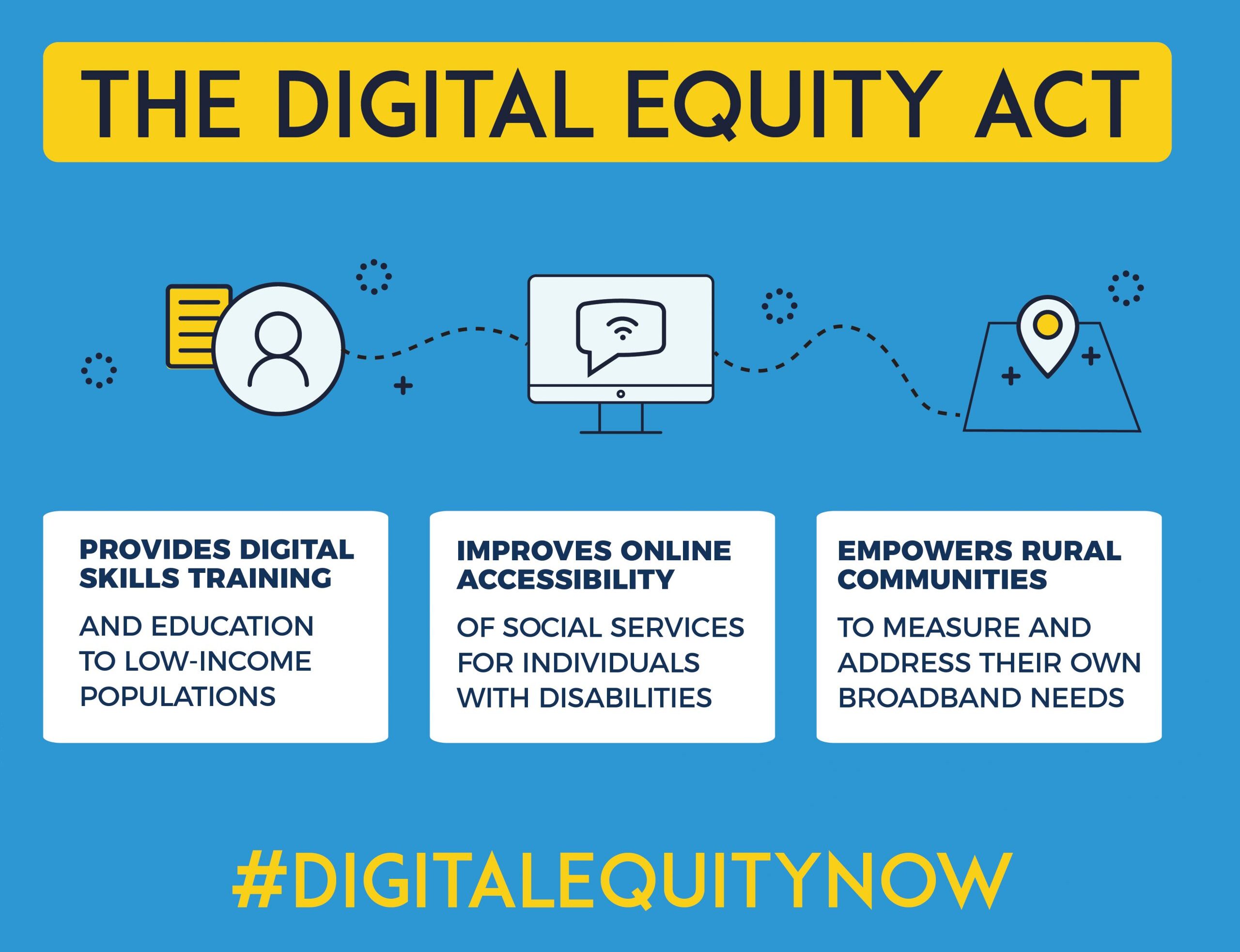
Centralized action and support can drive local action at scale. The $2.75bn grant program that the US Congress passed in 2021 is designed to promote digital equity and inclusion by encouraging internet adoption in communities across the country. The Digital Equity Act has launched three grant programs to support a variety of personalized, localized broadband-adoption initiatives, with the onus on each state to develop and implement its own digital-equity plan, training, outreach and awareness campaign, and device support.
In 2020 the European Commission published the European Skills Agenda, which pressed member states to implement a dozen actions over the subsequent five years, in fields such as lifelong learning and vocational training.
The important point here is that there are no one-size-fits-all solutions. Inevitably, communities and individuals face different barriers to getting online and accessing digital services, depending on their circumstances. While there will be plenty of widely applicable lessons from different initiatives, effective programs will require a bespoke element. Local program leaders in specific communities are best placed to identify what is required.


Nicole Morgenstern warns that program leaders should not assume certain citizens simply aren’t interested in acquiring digital skills. The enthusiasm and interest is there, she insists; people just need to be given the opportunity to get online and start exploring. She points to a program recently run in Chinese for Chinese elders in Seattle, one enrolled member of which was able to secure a graphic design role even before graduating the program. Â
It’s a salutary tale. The internet can open up the world for people to whom it is closed in other respects, democratizing access to products, services, and opportunities by breaking down linguistic and geographical barriers. However, that promise will be completely undermined if a significant cohort of people – likely those from already marginalized sections of society – cannot get online in the first place.
Digital equity is, moreover, an imperative that must be addressed on a global scale. Research suggests that lack of access to the internet is a much more acute issue in many developing economies. In countries such as South Africa and India, for example, as many as 70% of people struggle to get online.
Improving digital equity should be a pillar of the global economic recovery from the Covid-19 pandemic, the United Nations argues. The UN also believes that a failure to close the digital gap will make achieving many of its Sustainable Development Goals (SDGs) much harder.
The bottom line is that, in our schools, hospitals, homes, and workplaces – indeed, throughout society – internet connectivity is now a necessity. Without such access, the digital age will leave the less fortunate behind. Everyone, regardless of their economic status, must have access to the basic tools that allow them to participate in this new world. Â

Researcher, TONOMUS Global Center for Digital and AI Transformation
Tomoko Yokoi is an IMD researcher and senior business executive with expertise in digital business transformations, women in tech, and digital innovation. With 20 years of experience in B2B and B2C industries, her insights are regularly published in outlets such as Forbes and MIT Sloan Management Review.

October 24, 2025 • by Luca Condosta, Alexander Fleischmann in Diversity, Equity, and Inclusion
Companies gain performance advantages through LGBTQ+ inclusion, yet nearly nine in 10 Swiss firms lag. Here’s how leaders can close the gap....

October 21, 2025 • by Vanina Farber in Diversity, Equity, and Inclusion
When talk of diversity triggers backlash, leaders face a paradox: how to advance inclusion goals while choosing language that keeps dialogue alive in hostile environments....

August 20, 2025 • by Francesca Annalisa Petrella, Fernando Alonso Pérez-Chao, Luca Condosta in Diversity, Equity, and Inclusion
While support for workplace LGBTQ+ programs has dropped to just 38% globally, cities with strong inclusion policies demonstrate four times higher human capital performance and double the innovation scores than their less...

July 11, 2025 • by Silke Mischke in Diversity, Equity, and Inclusion
While some organizations retreat from inclusion commitments under political pressure, the path to lasting transformation lies in embedding diversity deeply within core values rather than treating it as a compliance issue. Leaders...
Explore first person business intelligence from top minds curated for a global executive audience