
Is it possible to think of Finland, Iceland, Kazakhstan, Mongolia and New Zealand together as a group when you are thinking of your next vacation? Can we add to this group Australia, Canada, Iceland and Norway? In short, the answer to this question is: yes! Let me explain by providing a rather personal take on a day at the IMD World Competitiveness Center.
It all started a couple of weeks ago. It was the end of a busy and stressful week. The WCC team was working very hard for the upcoming launch of the IMD World Talent Ranking that takes place next week in Singapore. Have you ever had a day when your computer does not want to cooperate? Our computers seemed to have a bug that week; they ran very slow and made our job as difficult as possible. In the end, and after all the tasks were completed with much higher levels of anxiety than necessary, we all felt like the colleague who said: “I need a vacation right now!”
This seemingly innocent remark triggered a lengthy conversation. You see, the WCC team is a rather international group, made up of members with nine nationalities and the “best destination for a vacation” can spark an interesting debate. All of us have a fondness for our countries of origin. The fact that we work closely with so many different countries, on the other hand, makes us yearn to visit several of them to explore their cultural treasures and the unique tourist destinations they offer. The issue at hand: How to choose from the list of the 63 economies we study?
The economist among us employed the standard answer used in cases of trade-offs: “It depends” he said, invoking the response to difficult questions from students in class! Does one want to be in “happening” places full of sounds, loud music and people who seem to forget whether it is day or night? Or does one want to be in a quiet, secluded place where you can relax and feel far … far … away from concerns of any kind?
What about safety, asked the one with young children? Personal security is not only a concern for those who have children, retorted the more rational among us. You have guessed what followed: “Let’s use our dataset to find out” was the suggestion of the “numbers-person” among us.
The tourism receipts as a percent of GDP is a candidate for measuring how crowded a place is. However, this variable does not take into consideration the large countries with an abundance of open space. An alternative proxy, therefore, is to use the population density of the countries!
And regarding safety we can use the responses from the personal security question from the IMD Executives Opinion Survey!!! So, we are done!
“Not so fast,” said the thoughtfully frugal among us. The cost of vacation is a very important determinant as well. In other words, we need to consider the “value for money” component as well if we are serious about this. To take this into consideration we can include the cost of living in a country!
Great, now we are done! And what does this give us? The designer among us provided a visualization of the exercise: Figure 1.
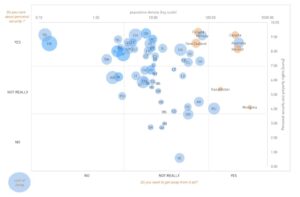
Source: IMD World Competitiveness Center Dataset
Horizontally we account for the population density (in logarithms.) We give an answer to the question “Do you want to get away from it all?” by separating three areas: on the left the densest countries while on the right the least dense with respect to population. And vertically, we answer the question “Do you worry about personal security?” Again, there are three distinct parts: on the top the countries whose upper- and mid-level managers perceive as more secure while in the bottom the ones where personal security can be improved upon. Finally, the comparative cost of living among the 63 economies we study comes from the size of the circle representing each country. The larger the circle, the most expensive the country is.
Examining Figure 1, you can now observe how Canada, Finland, Iceland, Kazakhstan, Mongolia and New Zealand may belong in the same group of possible traveling destinations. At least with respect to the chosen criteria.
Which one is the destination that each of us chose? Well, you know the answer: It depends!
Given the holidays that are rapidly approaching like Thanksgiving, winter-break, or even, for the more organized among us, summer vacation, the question is: Which country will you choose?
Happy vacation dreaming !




Research Information & Knowledge Hub for additional information on IMD publications
Research Information & Knowledge Hub for additional information on IMD publications
Research Information & Knowledge Hub for additional information on IMD publications
Research Information & Knowledge Hub for additional information on IMD publications
Research Information & Knowledge Hub for additional information on IMD publications
Research Information & Knowledge Hub for additional information on IMD publications
Research Information & Knowledge Hub for additional information on IMD publications
Research Information & Knowledge Hub for additional information on IMD publications
Research Information & Knowledge Hub for additional information on IMD publications
Research Information & Knowledge Hub for additional information on IMD publications