
Stop, drop & roll. Everybody knows what to do should they catch on fire.
By contrast, financial literacy is extremely low, and many people lack a basic understanding of financial management. A record number of people have accumulated a record level of debt. What are some simple rules of financial management we should follow?
Financial analysts claim it’s not so simple. Financial investments are inherently complex, and simple rules beyond “don’t put all your eggs in the same basket” directive are hard to come by.
However, some help can come from the unexpected realm of cryptocurrency trading.
In contrast to traditional financial instruments like stocks or bonds, trading in bitcoin and other cryptocurrencies trading attracts a much younger and digitally savvy crowd. They share lots of information, knowledge, and trading strategies on specialized online forums, most prominently on Reddit (see r/Bitcoin and r/CryptoCurrency). There you will most certainly encounter the use of several acronyms ubiquitous in the world of crypto.
Using these short and catchy abbreviations, cryptocurrency traders easily remember the most important rules of trading that — hopefully — help them to avoid costly mistakes. But non-crypto investors can learn and use them too.
Many of the underlying concepts have their origins outside the cryptocurrency world but have been borrowed and appropriated accordingly. For example, FOMO — the fear of missing out — was coined by Patrick J. McGinnis in a 2004 op-ed published in the Harvard Business School magazine The Harbus. In a trading context, it refers to the fear of missing out on high returns, triggered by recent, often drastic increases in the market value of an asset (think bitcoin or Ethereum).
Consequently, FOMO triggers newcomers to place large investments after course jumps, based on the inherently human cognitive bias to extrapolate the future from the past. Common trading wisdom, however, argues the opposite and generally advises to buy at the end or after a recent dip, or as another simple crypto-trading rule states: BTFD (buy the f-ing dip).
A common reddit thread occurs like this:
Question: Hey! Bitcoin has just gained 15% in price since yesterday, how long do you think it will continue? How much should I buy?
Answer: Relax, Bitcoin is very volatile and has these movements multiple times per month. Don’t let FOMO drive your investment decisions. My recommendation is to wait for the next downturn and BTFD!
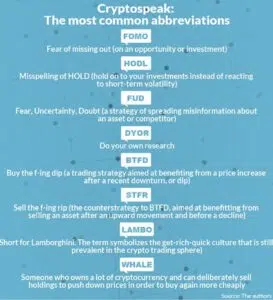
Another great and simple rule is DYOR — do your own research. Some commentators describe the widespread cryptocurrency hype as the new Wild West. And just like the original Wild West, it attracts predatory or even fraudulent actors trying to entice naïve traders with promises of extraordinary returns if they only follow their investment strategy. Reddit contributors strongly caution DYOR — a rule to follow for traditional investments as well, as some recent cases of faulty advisory have shown.
Read: This Utah case is a lesson in why you shouldn’t let friends or family pick your financial adviser
In times of hyperconnectivity, information overload and never-ending FUD (fear, uncertainty, and doubt), such simple rules can help overcome cognitive biases and carefully evaluate investment opportunities. And while these acronyms are too simple to replace real financial educational and policy initiatives, they are easy and effortless to memorize and hard to misinterpret.
Read: Teaching people about money doesn’t seem to make them any smarter about money – here’s what might
Nikolaus Obwegeser is a researcher at the Global Center for Digital Business Transformation at the IMD business school and a joint initiative with Cisco. Remy Assir is operations manager and Tomoko Yokoi is a researcher, also at the Global Center for Digital Business Transformation.
This article was first published by MarketWatch






Research Information & Knowledge Hub for additional information on IMD publications
Research Information & Knowledge Hub for additional information on IMD publications
Research Information & Knowledge Hub for additional information on IMD publications
Research Information & Knowledge Hub for additional information on IMD publications
Research Information & Knowledge Hub for additional information on IMD publications
Research Information & Knowledge Hub for additional information on IMD publications
Research Information & Knowledge Hub for additional information on IMD publications
Research Information & Knowledge Hub for additional information on IMD publications
Research Information & Knowledge Hub for additional information on IMD publications
Research Information & Knowledge Hub for additional information on IMD publications